
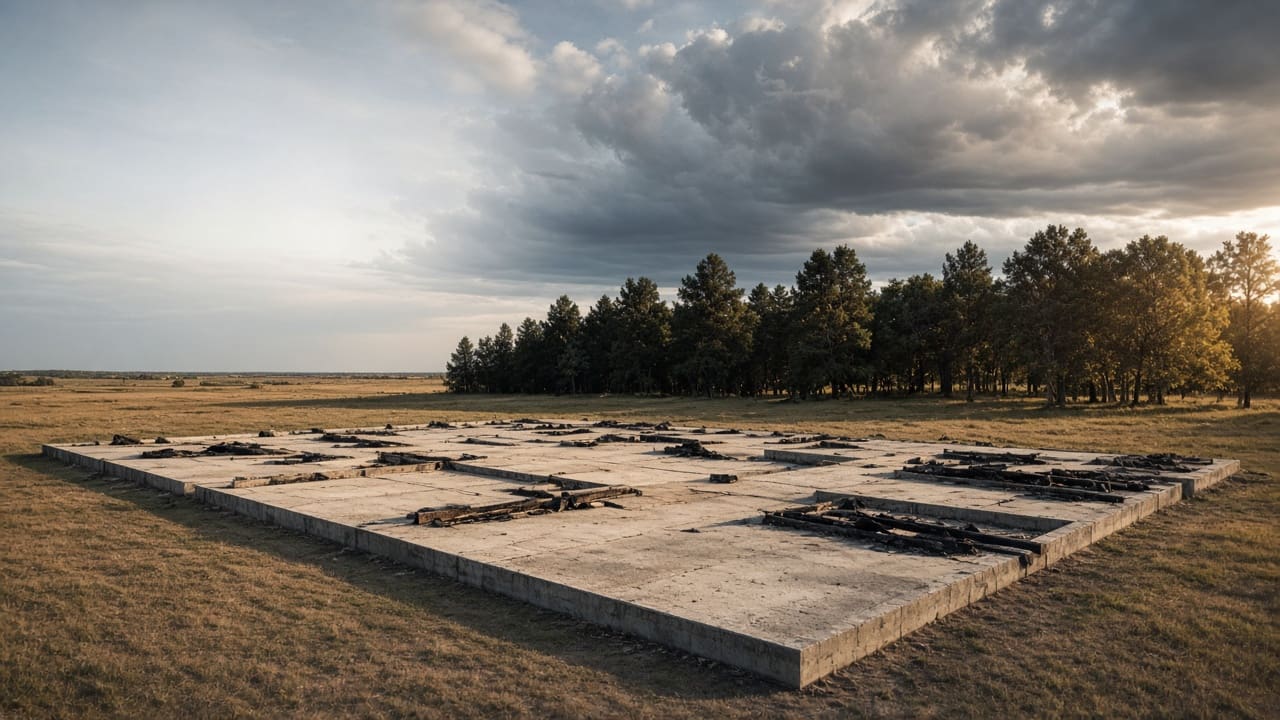
On June 20, 2025, a tornado more than a mile wide touched down south of Enderlin, about 55 miles from Fargo. That October, the National Weather Service upgraded it to an EF5, with winds over 210 miles an hour. It was the first EF5 tornado in the United States in twelve years, and it ended its path in Cass County.
At one farmstead, the weather service wrote that the foundation was “swept clean.”
When a house is gone like that, the question becomes “How much do I get paid, and what do I do now?” Here’s how a total loss on a $1M+ home works, and the decisions successful families in North Dakota and Minnesota will face.
The basics: how a total loss gets paid
Prefer to listen? Hear Episode 1 of The Replacement Cost.
Rebuild cost is not market value
Most homes are insured for what they would cost to rebuild, not what they would sell for. Market value includes the land and the neighborhood. Rebuild cost is labor, materials, and time.
In a 2022 survey for the American Property Casualty Insurance Association, 64% of insured homeowners said they weren’t sure, or believed, their coverage was based on market value.
The gap can be large. In 2025, a newly built estate on Lake Minnetonka was listed for $55 million, and the listing agents told the Star Tribune that price was about half of what it would cost to build today.
Rebuild costs keep climbing
- Verisk, which tracks rebuild costs for insurers, found national residential rebuild costs rose 43.9% from October 2019 to October 2024.
- Verisk’s July 2026 report shows labor costs rising more than twice as fast as materials (4.7% vs. about 2.1% over the prior year).
- Locally, the CEO of the Building Industry Association of the Red River Valley told WDAY in July 2026 that copper was up 35% this year, citing “a crisis in skilled labor.”
What your declarations page tells you
Your declarations page shows the amount for the house and how the policy pays. On some of the policies we write, a total loss is paid at what it would cost to rebuild the same house, with the same quality of materials and workmanship, up to that amount.
Depending on the carrier, you may also have extended replacement cost, which can pay more than the amount on the page if rebuilding costs more than expected. Some policies have guaranteed replacement cost, which works in a similar way.
The nuances: where successful families get surprised
Rebuild, rebuild somewhere else, or take the money
On some of the policies we write, a total loss is paid at the rebuild cost, up to the house amount, whether or not you actually rebuild.
The catch: on those same policies, the extra coverage above the limit only applies if you rebuild at the same location and start within 180 days, or a later date the company agrees to. If you take the money or build somewhere else, the most you’ll get for the house is the amount on the page. If you have a mortgage, the lender is paid from that money too.
Building code upgrades
A rebuild may have to meet today’s codes. Some policies include coverage for that extra cost; on others, it’s something you add. On some of the policies we write, code coverage only applies if you rebuild at the same location.
Minnesota has a state law on code upgrades for replacement cost policies. In July 2025, the Minnesota Supreme Court applied it to a St. Paul homeowner’s hail-damaged roof. The contractor couldn’t install new shingles on the old roof boards under code, and the court held the insurer had to pay $5,600 for the new layer underneath. It was a roof repair, not a total loss, but code costs are real.
Debris removal and the land
On some of the policies we write, debris removal is its own coverage on top of the house amount, and there’s a limited amount for work on the land under and around the house.
Where you live during the rebuild, and the 180-day clock
On some of the policies we write, the extra cost of living somewhere else is covered, so your household can keep its usual standard of living, for up to two years from the date of loss or longer if the company agrees. On those policies, you have 180 days to tell the company whether you’ll rebuild, repair, or move for good. If you don’t, that coverage can end 30 days later.
Winter makes the clock tighter. A loss the day before Thanksgiving puts the 180-day mark in late May. The City of Blaine, Minnesota, cancels inspections when it’s 0°F or colder at 8 a.m. unless protection is in place, and fresh concrete in deep cold may need a heated enclosure for two to three days.
Everything inside the house
Your belongings have their own coverage amount. On some of the policies we write, you’re required to make an inventory of what was damaged, describe it in full, and back it up with receipts and other records. In the 2022 APCIA survey, 25% of insured homeowners said they had never made a home inventory.
Keeping the number current
On some of the policies we write, full rebuild coverage depends on carrying at least 90% of the amount the company recommends. On those policies, it’s your job to tell your agent when you remodel or add on. Depending on the carrier, an unreported large project can bring a special deductible, and a large project can change how a claim is paid until it’s finished, even when it’s reported.
State law
Both North Dakota and Minnesota have laws on the books about what’s owed when a building is completely destroyed. How they apply to your policy is a question for a licensed professional looking at your actual policy.
If your home would cost more than $1 million to rebuild, here’s how we approach coverage for homes like yours.
A real example: what the data shows after a total loss
Some of the best total-loss data comes from Colorado’s Marshall Fire, which destroyed more than 1,000 Boulder County homes in late 2021.
- Colorado’s Division of Insurance reviewed 951 total-loss claims. Only 8% had guaranteed replacement cost.
- Depending on rebuild cost per square foot, the regulator estimated 36% to 67% of those homes were underinsured.
- Two years later, 79% of families surveyed by United Policyholders said they didn’t have enough insurance to rebuild, even though most reported having extended replacement cost.
Colorado’s laws differ from ours, but big losses happen here too. In May 2025, the Camp House Fire near Brimson, north of Duluth, destroyed about 150 structures, including dozens of homes and cabins.
3 things to do this week
- Find your declarations page. Write down the amount on the house, the words that say how it pays (such as extended or guaranteed), and whether you have coverage for building codes.
- Walk through your home with your phone and take a video. Open closets and drawers. Save it somewhere outside the house, like the cloud.
- List every project since your last coverage review, such as a kitchen, finished basement, new windows, or an addition, and send that list to your agent.
Frequently asked questions
Is my home insured for market value or rebuild cost?
Usually rebuild cost, which is the labor and materials to put the house back. Market value also includes land and location, so the two can be far apart.
Do I get paid if I don’t rebuild after a total loss?
On some of the policies we write, yes, up to the house amount, whether or not you rebuild. But extra coverage above the limit typically requires rebuilding at the same location and starting within 180 days, or a later date the company agrees to.
How long will insurance pay for living expenses after a fire?
On some of the policies we write, up to two years from the date of loss, or longer if the company agrees. On those policies, you have 180 days to say whether you’ll rebuild or relocate, or the coverage can end 30 days later.
Do I need a home inventory?
On some of the policies we write, you’re required to list damaged belongings in detail after a loss. A phone video of every room, saved outside the house, is a good start.
Want a second set of eyes?
Every policy is written a little differently, and the details on a total loss depend on your carrier and what’s in your policy. If you’d like us to take a look at yours, call us at (701) 237-6651 or request a coverage review at farnorthinsurance.com. We’re an independent agency in Fargo, and we work with families across North Dakota and Minnesota.
Sources
- National Weather Service Grand Forks, “Enderlin Tornado #1 Upgraded to EF-5,” Oct. 6, 2025: https://www.weather.gov/media/fgf/Enderlin.pdf
- Western University, “Research assists with rating historic EF5 tornado in northern United States,” Oct. 6, 2025: https://news.westernu.ca/2025/10/ef5-tornado-enderlin/
- InForum, “North Dakota governor tours tornado damage in Enderlin” (distance from Fargo), June 25, 2025: https://www.inforum.com/news/north-dakota/north-dakota-governor-tours-tornado-damage-in-enderlin-from-once-in-a-generation-storm
- APCIA homeowners survey (Harris Poll, April 2022), as reported May 6, 2022: https://programbusiness.com/news/survey-finds-majority-insured-homeowners-risk-being-underinsured-amid-high-inflation-increased/
- Minnesota Star Tribune, “Lake Minnetonka mansion, Minnesota’s most expensive, lists at $55M,” May 30, 2025: https://www.startribune.com/lake-minnteonka-68-55-million-house-for-sale-listed-on-market-most-expensive-mansion/601363124
- Verisk, “Residential and Commercial Reconstruction Costs Rose Over 60% the Past 10 Years,” Jan. 23, 2025: https://www.verisk.com/company/newsroom/residential-and-commercial-reconstruction-costs-rose-over-60-the-past-10-years/
- Verisk, 360Value Q3 2026 Quarterly Reconstruction Cost Analysis, July 2026: https://www.verisk.com/4a2def/siteassets/media/underwriting-v/resources/360value-quarterly/360value-q3-2026-reconstruction-cost-analysis.pdf
- InForum / WDAY, “Housing costs continue to challenge homebuyers,” July 22, 2026: https://www.inforum.com/news/fargo/housing-costs-continue-to-challenge-homebuyers
- Minnesota Statutes, section 65A.10: https://www.revisor.mn.gov/statutes/cite/65A.10
- Minnesota Supreme Court, opinion in No. A23-0519, filed July 30, 2025: https://mn.gov/law-library-stat/archive/supct/2025/OPA230519-073025.pdf
- City of Blaine, MN, “Cold Weather Concrete and Masonry Work”: https://www.blainemn.gov/4224/Cold-Weather-Concrete-and-Masonry-Work
- Colorado Division of Insurance, “Initial Estimates of Underinsurance for Homes in the Marshall Fire,” April 26, 2022: https://doi.colorado.gov/news-releases-consumer-advisories/division-of-insurance-releases-initial-estimates-of
- United Policyholders, Marshall Fire 24-Month Survey Report, 2024: https://uphelp.org/wp-content/uploads/2024/03/2021-Marshall-Fire-24-Month-Survey-Report.pdf
- United Policyholders, Marshall Fire Impact Report, Oct. 2025: https://uphelp.org/wp-content/uploads/2025/10/United-Policyholders-Marshall-Report-Digital-Spreads-FINAL.pdf
- MPR News, “After nearly two weeks, crews are getting the upper hand on northern Minnesota wildfires,” May 22, 2025: https://www.mprnews.org/story/2025/05/22/after-nearly-two-weeks-crews-are-getting-the-upper-hand-on-northern-minn-wildfires
- Policy terms described as “on some of the policies we write”: North Dakota policy forms from one of the carriers Far North Insurance writes (effective Nov. 18, 2024). Page citations are kept on file at Far North Insurance.
This article is general information, not advice about your policy. Coverage depends on your policy and your carrier. Talk with a licensed agent about your situation.